Irish School Uniform Cost Estimator
Use this tool to estimate how much you might save annually by adhering to a standard uniform policy versus maintaining a trendy casual wardrobe for your child's schooling.
Your Estimated Annual Comparison
Total Uniform Cost
€0
Total Casual Cost
€0
Potential Savings: €0
By sticking to the standard uniform policy, you could save approximately 0% compared to a casual dress code approach.
Note: This calculation assumes one student. Multiply these figures by the number of children in secondary education for household impact. Remember to check local PTA swap shops to reduce initial uniform outlay further.
You walk into a secondary school in Galway or Dublin, and you see it instantly: the blazers. Whether it’s the sharp navy of a local community school or the distinctive green trim of a prestigious college, school uniforms are woven into the fabric of Irish education. But why do we still insist on them? It’s not just about tradition or keeping teachers happy. There is a solid, practical logic behind the policy that affects everything from your morning routine to your child’s social standing.
The debate often flares up in staff rooms across the country, but the consensus among most principals and parents leans heavily toward one side: uniforms work. They simplify life, reduce stress, and create a level playing field in classrooms where economic differences can otherwise become glaringly obvious. If you’re weighing up the pros and cons for your own family, or just curious about the rationale, here is what the evidence and experience actually say.
Eliminating the Morning Panic
Let’s be honest with ourselves-mornings in an Irish household are rarely calm. Between getting kids out the door for the Bus Éireann pickup and finding that one missing sock, chaos is the norm. A strict dress code removes the biggest variable from the equation: decision fatigue. When a student knows exactly what they need to wear, there is no hour-long negotiation over whether those jeans are "too ripped" or if that hoodie fits the school's vibe.
This predictability saves time. For parents working early shifts in hospitals like Merlin Park or corporate offices in Dublin’s Docklands, those extra ten minutes are precious. It also reduces conflict. You aren’t arguing about fashion choices; you are simply checking off a list. Blazer? Check. Tie? Check. Shoes polished? Check. Done. It turns a potential battleground into a simple logistical task.
Breaking Down Socioeconomic Barriers
Ireland has made great strides in equality, but wealth disparity is still visible in our schools. Without a uniform policy, clothing becomes a status symbol. Brands matter. In a non-uniform environment, a student wearing unbranded clothes might feel judged compared to a peer in expensive designer labels. This isn't just superficial vanity; it impacts confidence and participation.
School uniforms act as a great equalizer. When everyone wears the same grey trousers and white shirt, the focus shifts away from who has the latest Nike trainers and back to who did their homework. It minimizes bullying based on appearance. While some argue that branded uniforms can be expensive, many Irish schools have moved toward generic suppliers or allow parents to buy second-hand options, making compliance more affordable than maintaining a wardrobe of trendy, high-end casual wear.
| Item Category | Uniform Policy Cost | Casual Dress Code Cost |
|---|---|---|
| Core Clothing (Blazers, Trousers, Skirts) | €150 - €250 (One-off/Seasonal) | €400+ (Constant updates needed) |
| Footwear | €60 - €80 (Standard black shoes) | €100+ (Trend-dependent sneakers) |
| Accessories (Ties, Belts) | €20 - €30 | N/A |
| Total Estimated Annual Spend | ~€250 - €350 | ~€500 - €700+ |
Fostering a Sense of Belonging
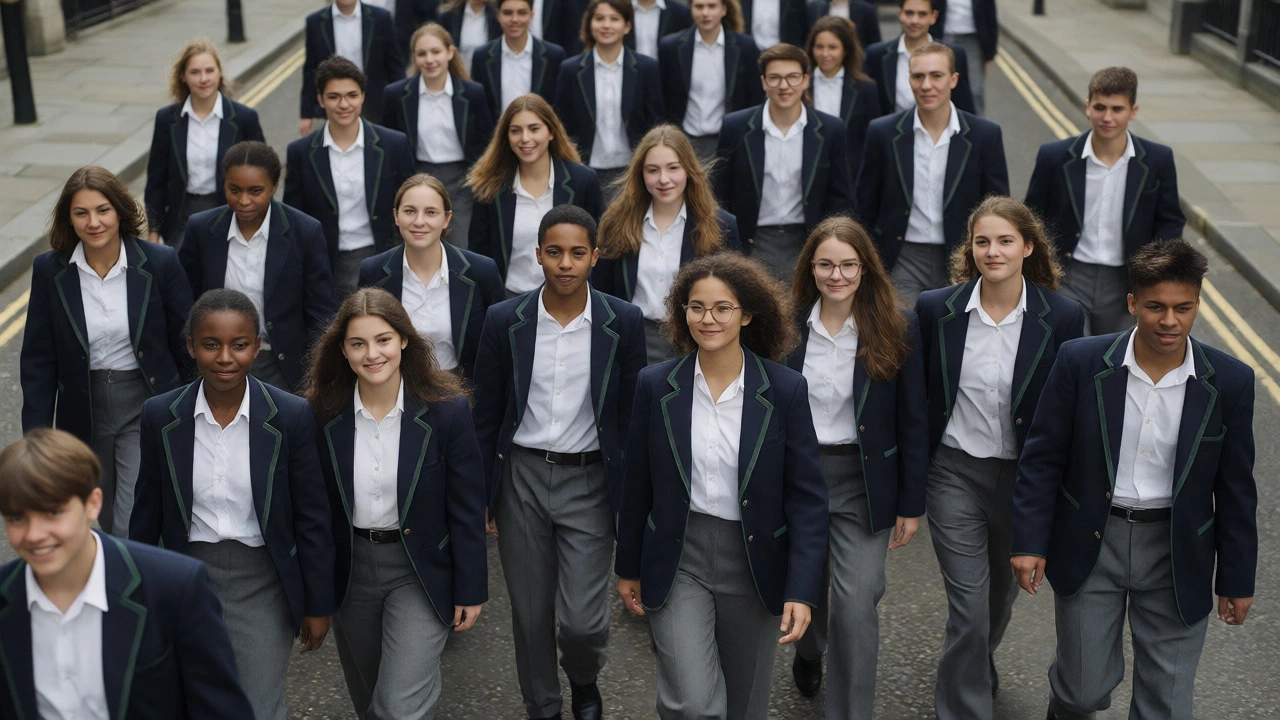
There is something powerful about walking through the gates of a school and seeing hundreds of faces in the same colors. It creates an immediate sense of identity. In smaller towns across the West of Ireland, the local school is often the heart of the community. The uniform reinforces that connection. Students feel part of a team, much like supporters at a GAA match wearing their county jersey.
This collective identity helps during transitions, such as moving from primary to secondary education. New students in first year often feel anxious. Wearing the uniform signals that they belong, that they are now part of this new group. It reduces the feeling of being an outsider. Teachers often report that students take pride in representing their school when they look smart and unified, leading to better behavior and less disruption in class.
Improving Focus and Reducing Distractions
Adolescence is hard enough without worrying about what everyone else thinks of your outfit. Clothing can be a major distraction. Is my top too low? Are these shorts too short? Does this slogan offend someone? By removing these variables, schools clear the mental space for learning.
When the visual noise of varied fashion styles is removed, attention naturally shifts to the lesson. Teachers spend less time policing dress codes for appropriateness and more time teaching. It’s not about suppressing individuality entirely; students still express themselves through haircuts, accessories allowed by policy, and their personalities. But the classroom itself becomes a neutral zone dedicated to academic work, not a runway.
Safety and Security Benefits
In larger urban areas like Cork or Limerick, safety is a genuine concern. Uniforms make it easier to identify students who belong to the school and spot intruders. If a stranger walks onto campus, they stand out immediately because they aren’t wearing the standard blazer or tie.
It also helps during off-site trips. Taking a group of Transition Year students to the National Museum in Dublin or a field trip to the Cliffs of Moher is logistically simpler when everyone is easily identifiable. Parents and teachers can keep track of numbers quickly. In crowded places, losing sight of a student in a sea of similar uniforms is harder than spotting one kid in a unique, bright yellow jacket among a crowd of strangers.
Addressing the Counter-Arguments
Of course, not everyone loves the idea. Critics argue that uniforms stifle creativity and self-expression. They point out that teenagers need to explore their identities, and clothes are a key tool for that. There is also the issue of comfort. Traditional blazers can be stifling in a warm June afternoon, and stiff collars aren’t exactly cozy.
However, modern policies are adapting. Many Irish schools now allow polo shirts instead of button-downs, permit tracksuits for PE days, and use breathable fabrics. The rigidity of the past is softening. Furthermore, self-expression doesn’t disappear; it just moves to other outlets like art, sports, music, and digital spaces. The argument that uniforms crush personality hasn’t held up against the reality of vibrant, creative students who happen to wear matching ties.
Practical Tips for Managing School Uniforms in Ireland
If you are navigating the world of school uniforms, here are some concrete tips to make it easier:
- Buy Quality Over Quantity: Invest in durable blazers and trousers. Cheap fabric pills after two washes. Look for blends that hold shape.
- Check Second-Hand Options: Most Parent-Teacher Associations (PTAs) run swap shops. You can get blazers for €5-€10 that look brand new.
- Label Everything: Use iron-on name tags. Lost property piles in Irish schools are legendary. Your child will thank you when they find their jumper.
- Understand the Rules: Read the handbook carefully. Some schools ban specific logos or require plain black shoes. Don’t assume.
- Prepare for Weather: Keep a spare pair of socks and a waterproof coat handy. Irish rain is unpredictable, and wet feet ruin a school day.
The Long-Term Impact on Discipline
There is a psychological component to dressing for success. When a student puts on a blazer, they mentally switch modes. It’s a cue that says, "Work time." This ritual helps establish boundaries between home relaxation and school responsibility. Over years, this builds discipline and professionalism. Students learn to present themselves appropriately, a skill that serves them well in third-level education and future careers.
Employers in Ireland often note that candidates who attended uniformed schools tend to understand workplace norms quicker. They know how to adhere to standards without constant reminders. It’s a subtle training ground for adult life.
Are school uniforms mandatory in all Irish schools?
No, not all schools enforce a strict uniform policy. While the vast majority of secondary schools in Ireland require a uniform, some community colleges and newer educational models may have looser dress codes. However, even these usually have guidelines regarding modesty and appropriateness.
How much does a full school uniform cost in Ireland?
Costs vary by school and supplier. A basic kit including blazer, trousers/skirt, shirts, and tie typically ranges from €200 to €350. Adding shoes, coats, and PE gear can push the initial outlay to €400-€500. Buying second-hand significantly reduces this expense.
Can students personalize their uniform?
Most schools allow limited personalization. This might include hairstyle, jewelry (often restricted to small studs), and sometimes specific brands of shoes or bags. However, major alterations like rolling up trouser legs or changing shirt colors are usually prohibited to maintain uniformity.
Do uniforms help with bullying?
Yes, research suggests that uniforms reduce bullying related to socioeconomic status and fashion trends. When everyone looks the same, it is harder to target someone based on their clothing brand or style, creating a more inclusive environment.
What happens if a student forgets their uniform?
Policies differ. Some schools provide loaner items for the day, while others may send the student home or impose a minor sanction. Consistently forgetting uniform is usually treated as a behavioral issue rather than an accident.