Irish Work Footwear Compliance Checker
Enter your workplace details to see if standard Crocs or specific safety footwear are required under Irish law.
Result
You’ve probably seen it happen. A nurse in a busy hospital corridor in Dublin, or a factory worker on a shift in Cork, wearing those iconic, hole-riddled clogs. It’s comfortable, sure. But is it actually against the law? Specifically, does wearing Crocs constitute an OSHA violation? The short answer is: no, because OSHA doesn’t exist here. But that doesn’t mean you’re off the hook.
In Ireland, we don’t have the Occupational Safety and Health Administration (OSHA). That’s a US agency. If you’re working in Ireland, your safety boots are governed by the Health and Safety Authority (HSA) and specific EU regulations. So, when someone asks if Crocs are an OSHA violation, they’re really asking: "Are these shoes safe enough for my job under Irish law?" The answer depends entirely on what you do for a living. Let’s break down why this question pops up so often and what the actual rules are for work shoes in Ireland.
The Myth of OSHA vs. Irish Reality
It’s funny how pop culture shapes our legal understanding. American movies and TV shows constantly reference OSHA fines. We see characters getting cited for not wearing hard hats or steel-toe caps. This creates a false sense of security-or panic-among Irish workers. In reality, the Safety, Health and Welfare at Work Act 2005 is the backbone of workplace safety in Ireland. Under this Act, employers must provide personal protective equipment (PPE) where risks cannot be adequately controlled by other means.
If your employer hands you a pair of standard Crocs and says, "These are fine," but you work in a kitchen with hot oil splashes or a warehouse with falling boxes, they might be breaking the law. Not because of OSHA, but because they failed to conduct a proper risk assessment. The HSA requires that PPE be suitable for the task, environment, and user. Standard foam Crocs fail most industrial tests. They offer zero protection against impact, puncture, or slips on oily surfaces.
When Are Crocs Actually Allowed?
So, can you ever wear them? Yes. Context is everything. In many office environments in Galway or Limerick, dress codes are relaxed. If you sit at a desk all day, there’s no heavy machinery, and no chemical spills, Crocs are rarely an issue. Some healthcare settings even allow specific types of clogs. However, these aren’t usually the classic beach-style Crocs. They are often clinical-grade footwear designed for hygiene and comfort during long shifts.
Consider the difference between a retail worker in Grafton Street and a construction worker in Temple Bar. The retail worker might stand for eight hours. Their feet hurt. Crocs provide arch support and cushioning. Unless the store has a strict uniform policy requiring leather shoes, they are likely compliant with general health and welfare standards. But swap that retail worker for a lab technician handling corrosive acids. Suddenly, those holes in the shoe become a liability. Acid can splash directly onto the skin. Foam absorbs liquids, making decontamination difficult. In this case, wearing Crocs isn’t just unprofessional; it’s unsafe.
Understanding Irish Safety Standards for Footwear
To know if your shoes are compliant, you need to look at the labels. In Ireland, as part of the EU, safety footwear must meet specific European Norms (EN). The most common standard is EN ISO 20345. This standard defines the requirements for safety footwear with a toe cap capable of resisting impacts equivalent to 200 joules.
Here is a quick breakdown of the common classifications you’ll see on shoe boxes:
| Category | Protection Level | Typical Use Case | Do Crocs Meet This? |
|---|---|---|---|
| SB | Basic safety toe cap (200J) | Light assembly, warehousing | No (unless specialized model) |
| S1 | SB + Anti-static + Energy absorption in heel | Indoor workshops, dry areas | Rarely |
| S2 | S1 + Water resistance (uppers) | Kitchens, light outdoor work | No (standard Crocs absorb water) |
| S3 | S2 + Penetration resistant sole + Cleats | Construction, agriculture, wet sites | No |
Standard Crocs do not carry an S rating. They are classified as casual footwear. There is a sub-brand called Crocs at Work that produces models like the Bistro Clog. These are designed to meet slip-resistance standards (often SRC rated). Slip resistance is crucial in Irish hospitality venues, from pubs in Derry to restaurants in Belfast. An SRC rating means the shoe passed both ceramic tile tests with detergent solution and steel plate tests with glycerol. If you work in food service, checking for this specific rating is vital.

The Role of Employers and Risk Assessments
Who decides if your shoes are safe? Your employer. Under Irish law, the employer bears the primary responsibility for ensuring a safe workplace. This involves conducting a risk assessment. If the assessment identifies a risk of foot injury from falling objects, sharp tools, or hot liquids, the employer must provide appropriate PPE.
Imagine you work in a fish market in Killybegs. The floor is wet, slippery, and full of scales. You also handle knives. A standard Croc offers poor grip on wet tiles and no cut protection. Your employer should provide non-slip, closed-toe boots with metatarsal guards if necessary. If they let you wear open-hole Crocs, and you drop a knife on your foot, who is liable? Likely the employer, for failing to enforce proper PPE usage.
However, employees also have duties. You must use the PPE provided correctly. If your employer gives you proper safety boots, but you switch to Crocs because your feet ache, you might be violating company policy. While you won’t get an "OSHA fine," you could face disciplinary action. In serious cases, if an accident occurs because you ignored safety gear, it could complicate any compensation claim.
Comfort vs. Compliance: Finding a Middle Ground
Let’s be honest. Safety boots can be heavy, hot, and uncomfortable. That’s why people love Crocs. They are lightweight, breathable, and easy to clean. For nurses working 12-hour shifts in hospitals like Mater Misericordiae University Hospital in Dublin, foot fatigue is real. Standing on hard floors all day takes a toll.
The good news is that the market has evolved. Many brands now produce "safety trainers" or hybrid clogs that look like casual shoes but contain composite toes and slip-resistant soles. Brands like Birkenstock Professional or specialized medical clogs offer similar comfort to Crocs but with better structural integrity. If you find yourself fighting with your boss over footwear, suggest a compromise. Look for footwear that meets the minimum EN ISO 20345 SB or S1 standard but prioritizes ergonomics.
Also, consider the climate. Ireland is rainy. Wet socks lead to trench foot and fungal infections. Breathability is key, but so is water resistance. A fully enclosed shoe made of breathable mesh with a waterproof membrane is often a better choice than a perforated clog, especially if you walk outdoors between buildings.

Special Cases: Healthcare and Hospitality
Two sectors frequently debate the Croc question: healthcare and hospitality.
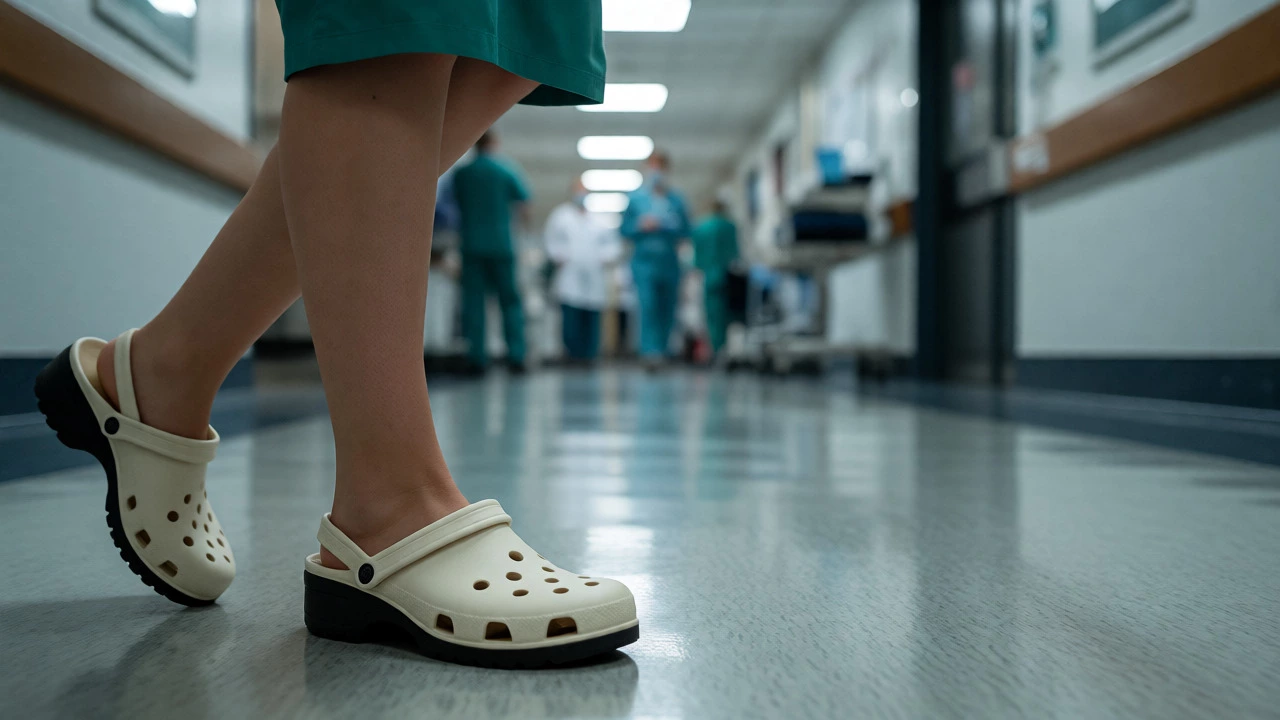
In healthcare, hygiene is paramount. Open holes in shoes can trap bodily fluids or contaminants. Many hospitals have strict policies banning open-toed or heavily perforated shoes unless they are specifically approved clinical clogs. These approved clogs are seamless, easy to disinfect, and slip-resistant. If you’re a student nurse in Cork, check your placement handbook. Most will specify "closed-back, non-slip, fluid-resistant footwear." Standard Crocs often fail the "fluid-resistant" test because the foam is porous.
In hospitality, the focus shifts to slip resistance. The HSA has issued numerous warnings about slips and trips in kitchens. A study by the HSA highlighted that falls were among the leading causes of workplace injuries in Ireland. Wearing shoes without proper tread increases this risk significantly. If you’re bartending in a busy pub in Galway, spilled beer and sticky floors are daily hazards. Crocs with smooth soles become ice rinks. Always opt for models with deep treads and certified slip ratings.
What Happens If You Ignore the Rules?
There is no government inspector walking around Dublin offices with a clipboard, fining you for wearing Crocs. The enforcement mechanism is different. If an accident happens, the investigation looks back at compliance. Did the employee wear appropriate PPE? Was it enforced?
If you ignore a clear instruction to wear safety boots and injure yourself, your employer might argue contributory negligence. This doesn’t bar you from claiming compensation, but it can reduce the amount awarded. Conversely, if your employer fails to provide safe shoes, they face potential prosecution by the HSA. Fines for health and safety breaches in Ireland can be substantial, ranging from thousands to millions of euros depending on the severity and whether it’s a summary or indictment offence.
So, while you won’t receive a ticket labeled "OSHA Violation," the financial and professional consequences of ignoring footwear safety in Ireland are very real.
Practical Tips for Choosing Compliant Work Shoes
If you’re unsure about your current footwear, follow this checklist:
- Check the Label: Look for the CE mark and the EN ISO 20345 code. If it’s missing, it’s not certified safety footwear.
- Assess the Environment: Do you handle chemicals? Need chemical resistance (CI/CR codes). Working outside? Need water resistance (S2/S3).
- Prioritize Fit: Ill-fitting boots cause blisters and fatigue. Try them on with the socks you wear at work.
- Maintain Them: Cracked soles lose grip. Clean them regularly. Replace them when worn out, not just when they fall apart.
- Consult Your Employer: Ask for a copy of the risk assessment regarding PPE. It’s your right to know.
Remember, the goal isn’t just to avoid trouble. It’s to go home with the same number of toes you arrived with. Whether you’re stocking shelves in Tesco Extra or welding in a shipyard in Belfast, the right shoes make the difference.
Does OSHA apply to workplaces in Ireland?
No, OSHA (Occupational Safety and Health Administration) is a United States federal agency. In Ireland, workplace safety is regulated by the Health and Safety Authority (HSA) under the Safety, Health and Welfare at Work Act 2005 and various EU directives.
Can I wear Crocs in a hospital in Ireland?
It depends on the specific hospital's policy. Generally, standard Crocs are not allowed due to hygiene and safety concerns. However, many hospitals approve specific clinical clogs that are fluid-resistant, slip-resistant, and easy to clean. Always check with your department head.
What is the EN ISO 20345 standard?
EN ISO 20345 is the European standard for safety footwear. It specifies basic and additional requirements for safety footwear, such as toe cap impact resistance (200 Joules), slip resistance, and penetration resistance. Footwear meeting this standard is marked with the CE logo and the relevant classification (e.g., SB, S1, S3).
Are slip-resistant shoes mandatory in Irish kitchens?
While not explicitly named "slip-resistant" in every statute, the HSA requires employers to assess risks and provide suitable PPE. Given the high risk of slips in commercial kitchens, slip-resistant footwear (often rated SRC) is considered essential and effectively mandatory for compliance with safety obligations.
Can my employer force me to buy my own safety boots?
Under Irish law, if PPE is required for the job, the employer must provide it free of charge. They cannot deduct the cost from your wages. However, some companies may have agreements where they contribute towards the cost or require you to choose from a specific list of approved suppliers.