
Work Shoe Requirements Calculator for Ireland
Select Your Job Type
Select Your Job Hazards
Your Requirements
All safety footwear must carry the CE mark and meet European standards
Required Safety Features
Recommended Footwear Classification
Additional Notes
Where to Buy in Ireland
Get compliant footwear from these Irish suppliers:
- Workwear Direct (Limerick, Cork, Dublin)
- Safety Gear Ireland (Cork, Galway)
- Irish Workwear Supplies (Athlone)
- Claddagh Footwear (Galway)
- Shoe Zone (national chain)
When you’re working outdoors in Galway’s rain-slicked alleyways, on a Dublin construction site, or in a Cork food processing plant, your shoes aren’t just about comfort-they’re your first line of defense. In Ireland, where wet weather is the norm and uneven ground is the rule, work shoes must do more than look professional. They need to keep you upright, dry, and safe. The requirements for work shoes in Ireland aren’t just guidelines-they’re a matter of daily survival.
Legally Required Protection in Irish Workplaces
In Ireland, the Safety, Health and Welfare at Work Act 2005 is the law that governs workplace safety. It doesn’t just say employers should provide protective gear-it says they must. This means if your job involves heavy lifting, moving machinery, slippery floors, or exposure to chemicals, your employer is legally required to supply appropriate safety footwear-or give you the means to buy it.
Unlike in the U.S., where OSHA sets standards, Ireland follows European standards under EN ISO 20345. This means your work boots must carry the CE mark and meet specific criteria: steel toe caps, puncture-resistant soles, and slip resistance rated to at least SRC level. You’ll see these symbols stamped on the heel or tongue of any compliant boot. If it doesn’t have them, it’s not legal for industrial use.
For example, a warehouse worker at the Port of Dublin handling pallets of imported goods needs boots that can handle dropped crates and wet concrete. A kitchen hand at a Galway seafood restaurant needs soles that won’t turn a puddle of fish brine into a skating rink. Both are covered under the same law-but the exact type of boot differs based on risk.
Slip Resistance: The #1 Requirement in Ireland
Forget fancy designs. In Ireland, the most important feature of any work shoe is slip resistance. The average Irish worker spends more than 180 days a year walking on wet surfaces. Rain falls over 200 days annually in places like Connemara and Kerry. Even indoors, damp floors from melting snow, spilled liquids, or high humidity make slip hazards common.
Look for the SRC rating on the shoe’s label. That means it passed tests on both ceramic tile (SRA) and steel (SRB) surfaces covered in soapy water. Brands like Blundstone, Clarks Work, and Dr. Martens Industrial are widely available in Irish outlets like Workwear Direct in Limerick or Safety Gear Ireland in Cork. Avoid cheap imports sold at discount stores-they often fake the rating.
A real-world example: A mechanic in Waterford lost his balance on an oily garage floor in 2023 because he wore regular steel-toe boots without SRC certification. He broke his wrist. His employer was fined €12,000 for failing to provide compliant footwear. That’s not an outlier-it’s a pattern.
Steel Toe Caps and Puncture Protection: When You Need Them
Not every job needs a steel toe, but if you’re working in construction, manufacturing, or agriculture, you do. In rural Ireland, where farmers use tractors, chainsaws, and heavy feed bins, puncture-resistant soles are just as critical as toe protection. A stray nail, a broken bottle, or a dropped bolt can mean a trip to A&E-or worse.
Look for the S3 or S4 classification on the boot. S3 means toe protection, anti-puncture midsole, and water resistance. S4 adds full waterproofing. If you’re on a farm in Tipperary or working on a wind turbine project in Wexford, S3 is the minimum. S4 is better if you’re often in flooded fields or coastal zones.
Brands like Red Wing and Wolverine are imported and sold through Irish distributors like Irish Workwear Supplies in Athlone. Local brands like Claddagh Footwear (based in Galway) now make S3-certified boots with Irish-designed tread patterns that grip wet cobblestones and muddy laneways.

Waterproofing and Insulation: Because Ireland Doesn’t Have a Dry Season
Waterproof isn’t a bonus in Ireland-it’s a baseline. If your shoes soak through after an hour in the rain, you’re not just uncomfortable-you’re at risk of trench foot, frostbite in winter, or fungal infections. Look for boots with GORE-TEX lining or similar breathable waterproof membranes.
Insulation matters too. In winter, temperatures in the Midlands and Northern Ireland regularly drop below freezing. A construction worker in Derry or a utility technician in Sligo needs thermal lining. Some boots come with removable insoles for warmth, while others use Thinsulate™ or PrimaLoft®. Avoid leather-only boots unless they’re treated with waterproofing wax daily.
Many Irish workplaces now supply thermal work boots in winter months. If yours doesn’t, ask. Under the 2005 Act, employers must adjust protective gear for seasonal conditions.
Fit, Comfort, and Long-Term Use
A boot that pinches your toes after two hours isn’t safe-it’s a hazard. Poor fit leads to altered posture, back pain, and fatigue. In Ireland, where shift work is common (especially in hospitality and healthcare), you’re often on your feet for 8-12 hours straight.
Always try boots on in the afternoon, when your feet are swollen. Walk on a hard surface. Check for heel slippage. Look for cushioned midsoles and arch support. Brands like Keen and Merrell now offer work-specific models with ergonomic lasts designed for European foot shapes, which tend to be narrower than American ones.
Many Irish employers partner with local podiatrists for free foot assessments. Hospitals like Galway University Hospital and Beaumont in Dublin offer workplace foot clinics. Get one if you’re on your feet daily. It’s free under the Health and Safety Executive’s employee wellness program.
What to Avoid in Irish Work Shoes
Don’t buy generic ‘work-style’ boots from online marketplaces without checking the certification. A boot labeled ‘heavy duty’ or ‘tough sole’ doesn’t mean it meets EN ISO 20345. Many are imported from countries with lax standards.
Avoid shoes with smooth soles-even if they look stylish. A flat rubber sole might be fine for a city office, but not for a wet Dublin alley or a muddy farm gate.
And never wear second-hand safety boots unless you can verify their history. Scratches on the toe cap, worn treads, or faded labels mean the protection is compromised. In Ireland, a used boot that looks fine might have hidden damage from a previous fall or chemical exposure.
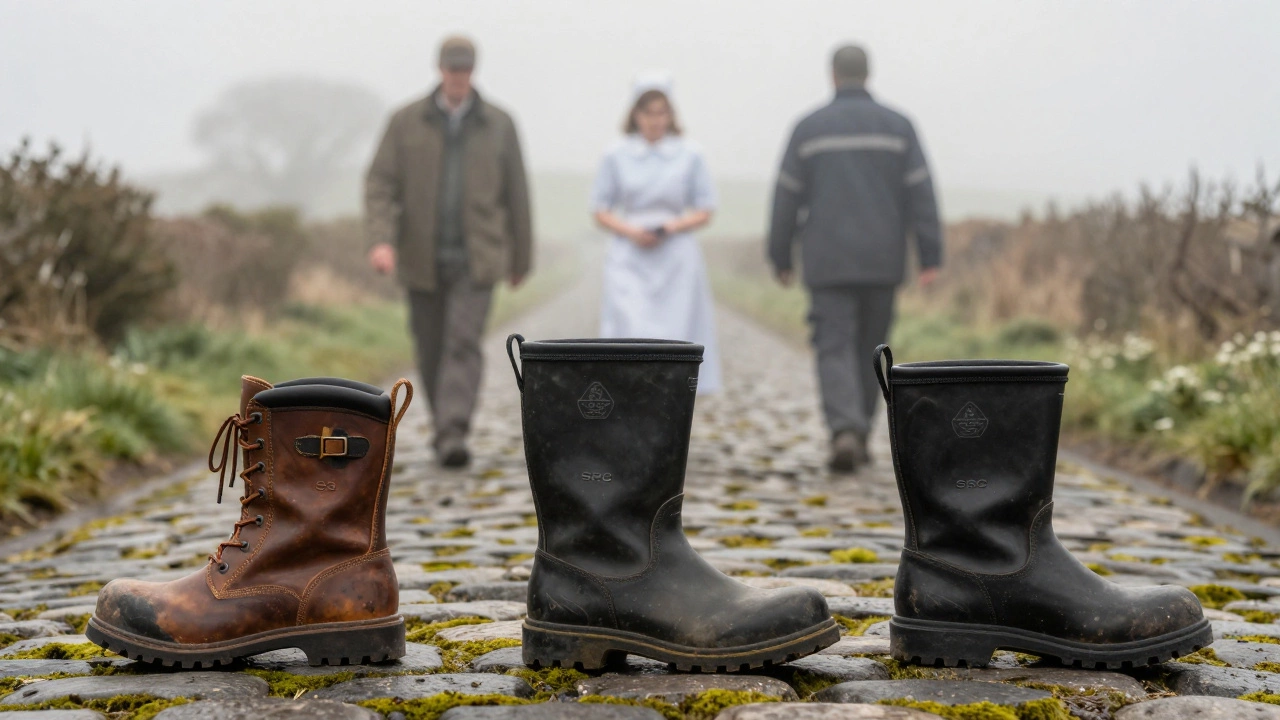
Where to Buy Compliant Work Shoes in Ireland
You don’t need to order from abroad. Ireland has a strong network of certified suppliers:
- Workwear Direct (Limerick, Cork, Dublin)-stocks full range of S3/S4 boots with CE labels
- Safety Gear Ireland (Cork, Galway)-offers free in-store fit checks
- Irish Workwear Supplies (Athlone)-specializes in agricultural and industrial footwear
- Claddagh Footwear (Galway)-Irish-made, designed for wet conditions
- Shoe Zone (national chain)-has a dedicated work shoe section with certified options
Many of these stores offer employer bulk discounts and VAT relief for businesses under the Workplace Safety Grant Scheme.
Replacing Your Work Shoes: When and How
Even the best boots wear out. Replace them every 6-12 months if you’re on your feet daily. Check the tread depth-if it’s less than 2mm, it’s time. Look for cracks in the sole, loose stitching, or a flattened midsole. If your foot feels like it’s sinking into the shoe, the cushioning is gone.
Some employers replace footwear annually as part of their safety protocol. If yours doesn’t, keep receipts. You can claim tax relief on safety footwear through Revenue’s PRSI scheme if you’re employed in a high-risk job.
Final Rule: It’s Not Optional
In Ireland, your work shoes aren’t a fashion choice. They’re a legal requirement, a health necessity, and a daily tool. Whether you’re a nurse in Limerick, a fisherman in Killybegs, or a builder in Belfast, your boots are part of your job. Get them right-or risk more than a blister.
Ask your employer for the safety assessment for your role. If they can’t show you the risk analysis or the approved footwear list, they’re not following the law. And if you’re self-employed? Don’t wait for permission. Your body is your biggest asset. Protect it.
Are work shoes mandatory in all jobs in Ireland?
No, not every job requires safety footwear-but any role with physical hazards does. This includes construction, farming, manufacturing, healthcare (especially in kitchens or wards), warehouse work, and any position with wet, slippery, or uneven floors. Employers must assess the risk and provide appropriate footwear if needed. If your job doesn’t involve these risks, regular shoes are fine.
Can I wear my own work shoes instead of the ones my employer provides?
Yes, as long as your boots meet EN ISO 20345 standards and are approved by your employer’s safety officer. Many workers prefer their own boots for comfort or fit. You’ll need to show proof of certification (the CE mark and S3/S4 rating). Employers can’t force you to buy from a specific store, but they can refuse non-compliant footwear.
Do I need waterproof boots if I work indoors?
If you work in a kitchen, hospital, or warehouse where spills are common-even indoors-yes. Ireland’s high humidity and frequent rain mean moisture gets tracked inside. Wet floors are a major cause of workplace slips. Waterproof or water-resistant soles are recommended in any environment where dampness is present, regardless of whether you’re inside or out.
Can I claim tax relief on work shoes in Ireland?
Yes, if you’re employed in a high-risk job and you paid for your own approved safety footwear, you can claim tax relief under the PRSI scheme. You need receipts and proof the shoes meet EN ISO 20345. The relief is 20% of the cost, up to €125 per year. Self-employed workers can claim it as a business expense.
What’s the difference between S3 and S4 work boots?
S3 boots have a steel toe, puncture-resistant midsole, and water-resistant uppers. S4 boots add full waterproofing-the entire boot is sealed against water ingress. S3 is fine for most indoor industrial jobs. S4 is essential for outdoor work, farming, or roles where you’re standing in puddles or wet fields regularly.